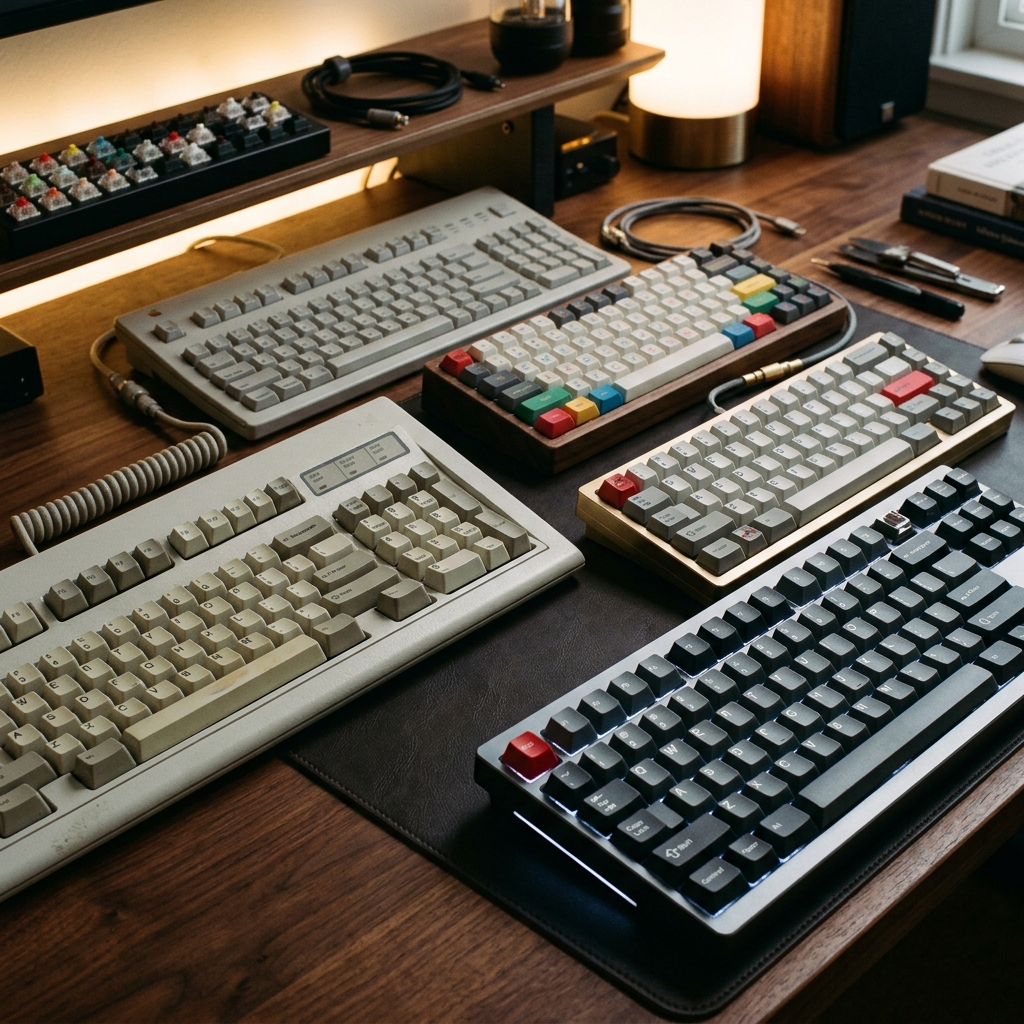
The keyboard you use today is the result of over 150 years of engineering, social change, and technological breakthroughs. What started as a heavy mechanical tool for office clerks has evolved into a high-precision input device used by billions for everything from gaming to heart surgery. Understanding this history helps us appreciate the tools we use every single day and where the future of typing is headed.
The Mechanical Era: 1860s - 1970s
The journey began with the commercial typewriter in the late 1800s. These machines used physical levers to strike an inked ribbon against paper. Interestingly, the QWERTY layout we use today was designed during this era to prevent these mechanical levers from jamming when common letter combinations were typed too quickly. It wasn't designed to be "fast," but to be "reliable" for the machines of the time.
The IBM Model M: The Undisputed Legend
In the 1980s, IBM released the Model M, often cited as the greatest keyboard ever made. It used "buckling spring" technology that provided a massive tactile and auditory click. Many of these boards are still in use today, nearly 40 years later, a testament to their incredible build quality. For many enthusiasts, the Model M remains the gold standard of tactile feedback.
The Rise of the Cherry MX Switch
In 1983, Cherry patented the MX switch, which would eventually become the industry standard for mechanical keyboards. By creating different "colors" (Red, Blue, Brown) with different tactile profiles, Cherry allowed users to choose a keyboard that matched their specific typing style. This modularity was the spark that ignited the modern custom keyboard movement.
The Membrane Revolution: 1990s - 2010s
As computers moved into the home in the 1980s and 90s, manufacturers looked for ways to make keyboards cheaper and quieter. This led to the rise of membrane keyboards, which use rubber domes to register keypresses. While affordable and portable, many typists felt these keyboards lacked the "tactile feedback" needed for high-speed typing, leading to the "mushy" feel that modern enthusiasts try to avoid. However, this era also saw the birth of the "Scissor Switch," which brought a slim profile to laptops and changed the way we type on the go.
The Modern Mechanical Renaissance: Customization and Craft
In the last decade, we have seen a massive return to mechanical switches. Typists and gamers realized that the "click" and "bump" of a mechanical switch actually help the brain register a successful keypress more quickly, reducing errors and increasing confidence. This has led to the "Custom Keyboard" hobby, where people spend hundreds of dollars on specialized cases, lubed switches, and "thocky" keycaps to achieve the perfect typing experience.
The Future: Hall Effect and Rapid Trigger
The latest frontier in keyboard tech is the "Hall Effect" switch. Using magnets instead of physical contacts, these switches allow for "Rapid Trigger" features where a key can be reactivated the moment it's released, regardless of its position. For elite gamers and ultra-fast typists, this hardware finally catches up to the speed of the human nervous system, allowing for unprecedented levels of responsiveness.
Conclusion: Choosing Your Tool
Whether you prefer the heavy click of a 1980s Model M, the slim travel of a modern laptop, or the magnetic precision of a Hall Effect board, your keyboard is an extension of your mind. By understanding the history and tech behind your tools, you can make an informed choice that enhances your comfort and your speed. Your perfect typing experience is out there—go find it!